What it’s really like to live with a reactive dog
I wrote this month-long diary a few years ago when I was experiencing quite a rollercoaster with my own dog. It was meant for a dog magazine but was never published, so here it is for your reading pleasure. Hopefully, it’ll make you feel less alone if you have a reactive dog. And spoiler: it does get better. Most of this is now unrecognisable to me!
In the canine world, “reactive” is a loaded term. It can mean so many things that it almost ceases to mean anything at all. But in a nutshell, a “reactive” dog is one that “overreacts” to specific situations, whether it’s people, dogs, objects, noises or all of them combined. This can come in the form of growling, barking, lunging – you get the picture. Bear in mind, this is an “overreaction” in the human’s eyes, not to the dog!
The cause can be complex, ranging from medical contributors like pain to emotions like frustration or fear. It can be very distressing for both the dog and their humans.
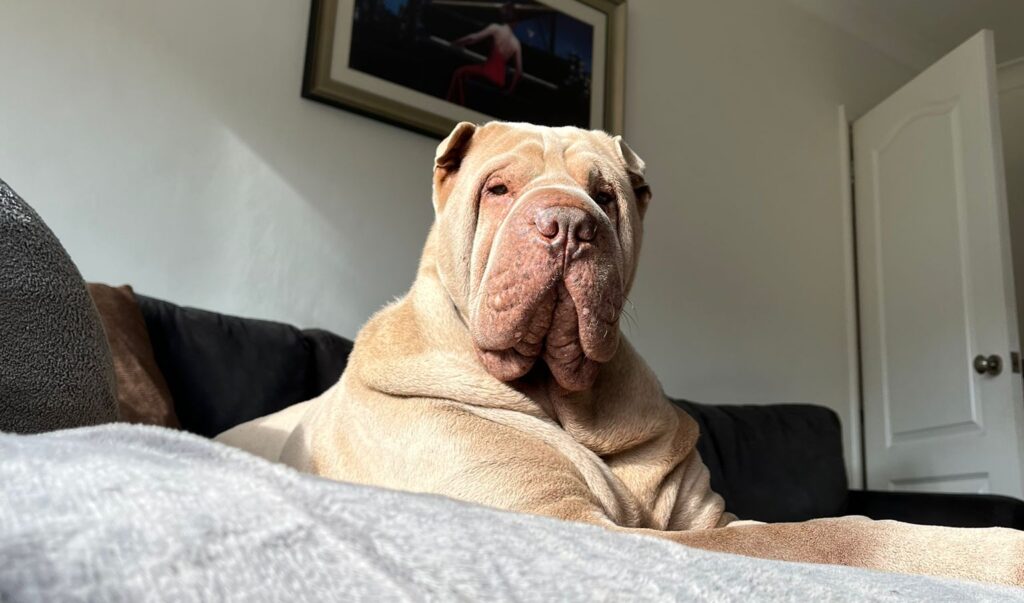
I would know because I have my very own reactive dog.
For a while, apart from a dislike of crowds and busy places, Winston seemed fine. But after a couple of minor bites from other dogs and several lunging and barking episodes from even more, his behaviour shifted.
He became increasingly anxious on walks. He would freeze when he spotted another dog or be almost racing to reach them. And then he’d lunge, bark, cry and growl all at once. I felt mortified, apologising and trying to get home as quickly as possible. I’d tighten the lead and quicken my pace to rush past, which made everything worse, but I couldn’t help it.
It wasn’t until I sought a behaviourist that a weight was lifted (and actually kickstarted my journey to becoming one myself!). We stopped walking every day, playing games indoors instead. And if we did venture out, we avoided places with other dogs and instead went to big, quiet fields where we could both relax. Eventually, I was able to start changing Winston’s negative associations to more positive ones.
Winston’s not “cured” though. I think I’ll always class him as a reactive dog and as pain is a contributing factor to his behaviour, there are still going to be ups and downs as he ages. But he is now living his best life and that’s all that matters.
So instead of wallowing in our tumultuous journey, I’m celebrating it by giving you an insight into what it’s really like to live with a reactive dog. Sometimes, you’ll laugh. Other times, you’ll cry. But it’s impossible to imagine life without them.
Week one: a reactive dog owner’s worst nightmare
After what feels like a lifetime, Winston is now able to glance at other dogs and look back for a reward. Or better yet, ignore them completely. He’s improved so much that we’re able to attend socialisation sessions with similar dogs. Half expected to be banished from the group. But Winston has been coping well and did so again today.
Later in the week, we’re out in Winston’s favourite field. Stop off to play a game of treat tree, where he licks cheese and sausages off the trunk. Winston’s busy scoffing his face. But I see the long grass in the distance start to move. Just like that, a tiny dog runs out and right up to Winston’s face. The dog incessantly barks and Winston freezes. It’s too close for comfort, and none of the training we’d done was going to work. Or so I thought. Magically, he turns back to look at me. I praise him and retrieve a treat while turning to walk away. And he follows!
Then I see the owner who’s finally made their way over. And then I spot the two other off-lead dogs. All three quickly surround Winston, barking and jumping. This time, he freezes for real. He’s terrified. I wish I could whisk him away, but he weighs almost 30 kilograms and I’ve been slacking in the gym. I try to remain calm, asking the owner to move their dogs on.
What’s probably only a couple of minutes feels like an eternity. When they finally leave, I look down and see a trickle of blood and two bite marks on Winston’s legs. Now, I’m angry – the owner didn’t apologise or even attempt to move quickly. But I have to prioritise Winston. I take him home, nurse his wounds and play indoors for the next few days to reduce his stress levels (and mine too).
A walk with a dog that Winston has been getting along with calms my nerves. He even attempts to play, although the older dog’s not interested! But the next day, he explosively reacts to a large dog who suddenly appears – a display I haven’t seen in months. He swiftly recovers, but it’s disheartening.
The takeaway: You’ll never control the actions of others, so focus on yourself and your dog.
Week two: some small wins
A week surprisingly full of highs. The boiler breaks, so an engineer comes round two days on the trot. Winston can be nervous of certain strangers entering the home – especially ones with noisy tools. But he relaxes pretty quickly from behind the child gate (a life-changing addition to your home if you have a reactive dog).
He also went to have his claws clipped at the vets. He’s grown to like one of the nurses so much that he actively approaches her and is rewarded with a treat. Thanks to her patience (and some more yummy treats), he no longer needs to be muzzled. Not to say that he loves the experience, but it’s a darn sight better than the state he used to come home in. 2023 update: I can now do all of this at home using these techniques with Winston remaining nice and relaxed. See, it does get better!
The next social walk arrives – the first one since Winston was bitten, so I’m nervous. Luckily, only a couple of dogs turn up and Winston is his usual unsociable self. He almost ignores the dogs from start to finish and does his own thing. The others even do recall training while Winston sniffs for treats – an amazing achievement as he can be nervous of dogs moving at speed. Only thing we need to work on now is the pulling. He rarely pulls in our usual walking areas, but it takes a while to accomplish the same in a new environment. Maybe we’ll master it this time next year!
The takeaway: Celebrate the little wins, no matter how inconsequential they seem.
Week three: a real rollercoaster
Winston’s social walk doesn’t go so well – he lunges at one of the dogs he’d previously been getting on with and then has to deal with a dog running off the lead. I berate myself under my breath as I try to look out for off-lead dogs. But sometimes they’re just so goddamn silent. Anyway, Winston copes from a distance and continues to walk. But when the dog runs too close, we have a second bout of lunging and barking.
The next day, Winston has his first massage session for both anxiety and arthritis. People laughed when I told them about it. But after experiencing the wonders of acupuncture for my migraines, I’m all up for trying complementary therapies. I’d explained to the massage therapist that Winston was nervous around strangers and may not take to massage at all. But she was willing to go at his pace. So when he allows her to touch him, even giving her kisses and offering parts of his body, I’m amazed. It shows the power of giving dogs space and choice.
The massage therapist said Winston may be lethargic or manic after his session. Thankfully, he goes down the former route, loudly snoring. He’s much calmer with the postman too – although one day, I misplace the squeezy cheese I use as a reward. So I have to improvise, offering him my empty cup of tea to lick. Surprisingly, it works a treat.
The takeaway: A massage and tea does everyone the world of good.
Week four: massage magic
I’m putting it down to the massage, but Winston has been so calm this week. He’s barely barking at the postman or pulling on walks and even manages to sleep through the builders next door throwing junk into a skip. And he’s continuing to make better choices. On a late evening walk in the woods, he takes himself in a different direction when an off-lead dog appears. No encouragement needed, making for a real proud moment.
Speaking of walks, they’ve all generally been good. But he gets stuck when a dog comes out of a drive and starts walking behind us. I try to guide Winston towards the other side of the road. But he stands firmly where he is. In the end, the other owner offers to cross. As soon as they do, Winston trots along as if nothing’s happened. I have to laugh.
Wondering if he should start donning his “I need space” vest from Yellow Dog UK again. Then again, people tend to ironically come closer to read it or, worse, say their dog can’t read…
The takeaway: If you get stuck, communication with your dog and with others is key.
A reactive dog reflection
After keeping this diary, I was feeling positive. Winston’s journey certainly is an uphill battle sometimes. But it’s slowly progressing. I try to remember this the next month when his anxiety unexpectedly worsens and the progress begins to unravel. After a vet check, we decide to trial behavioural medication. It’s yet another detour on our journey, with ups and downs as Winston deals with side effects and dosage changes. But the top of that hill is still within sight – and that’s all that matters.
2023 update: Winston is still on a combination of anti-anxiety and pain relief medication and this is key to him remaining behaviourally stable out and about. We have tried lowering the dose but this resulted in an increase in reactivity and general anxiety again. In fact, we’ve had to up the dose when his reactivity came back with a vengeance – likely due to pain from arthritis. Of course, when he has a little setback, we go back to some of our behavioural modification techniques to help him feel more relaxed around other dogs, people and loud noises. But on the whole, walks are now relaxing (and yes, they’re still in relatively quiet places as that’s what is best for him but do involve other dogs), we have fun, he’s able to respond to me when needed and rarely ever gets stuck!
I’m currently having my theoretical knowledge assessed. Once I pass, I’ll be able to start taking on behavioural cases with the ultimate goal of becoming a Clinical Animal Behaviourist (CAB). If you want to be notified when I’m taking on behavioural cases and would like to work with someone who knows what it’s like to live with a reactive dog, let me know below.